
What Bugs Eat Ants? The Ultimate Guide to Nature’s Tiny Predators

Introduction: The Ant-Eating Insects in Your Backyard
Ants are often seen as industrious, colony-building powerhouses, capable of defending themselves against much larger creatures. Yet, in the intricate web of the ecosystem, ants are not always at the top of the food chain. A surprising variety of insects and arachnids have evolved specialized strategies to hunt, parasitize, and consume ants. Understanding which bugs eat ants reveals a fascinating world of predation and adaptation right under our feet. This comprehensive guide will explore the most effective ant predators, their hunting methods, and their role in natural pest control.
Why Do Some Bugs Specialize in Eating Ants?
Ants are abundant, nutrient-rich, and often concentrated in predictable locations (nests and foraging trails), making them a reliable food source. However, they are also well-defended with strong jaws, stingers, and chemical weapons. The bugs that successfully prey on ants have developed unique counter-strategies, such as:
- Armor: Thick exoskeletons resistant to ant bites and stings.
- Speed & Ambush: Striking faster than ants can react.
- Chemical Mimicry: Disguising their own scent to infiltrate colonies.
- Specialized Tools: Modified mouthparts or limbs for capturing ants.
Top Insects and Bugs That Eat Ants
Here is a detailed look at the most common and effective ant predators.
1. Antlions (Family: Myrmeleontidae)
Famous for their larval stage, antlions are perhaps the most iconic ant predators. The larvae dig conical pits in sandy soil and lie in wait at the bottom. When an ant slips on the loose slopes, the antlion seizes it with massive, sickle-shaped jaws and injects digestive enzymes.
Key Features:
- Life Stage Specialization: Only the larvae are specialized ant predators; adults resemble damselflies and may not eat ants at all.
- Habitat: Sandy, dry, sheltered areas.
- Prey Preference: Primarily ants, but will consume other small arthropods.
2. Ant-Mimicking Spiders (Multiple Families)
Several spider species have evolved to look and smell like ants, allowing them to get perilously close to their prey. Examples include the Myrmarachne genus (jumping spiders) and some Corinna spiders.
Hunting Strategy:
- Visual Mimicry: They wave their front legs to mimic antennae and have constricted bodies to resemble an ant’s three segments.
- Chemical Camouflage: Some acquire the colony’s scent by killing an ant first.
- Direct Attack: They bypass colony defenses and deliver a swift, fatal bite.
3. Praying Mantises (Order: Mantodea)
While generalist predators, certain mantis species, especially smaller ground-dwelling varieties, actively hunt ants. They use their ultra-fast raptorial forelegs to snatch individual ants without getting bitten.
Risk: Ants can be dangerous prey for mantises due to their defensive swarming, so mantises typically prey on solitary foragers.
4. Robber Flies (Family: Asilidae)
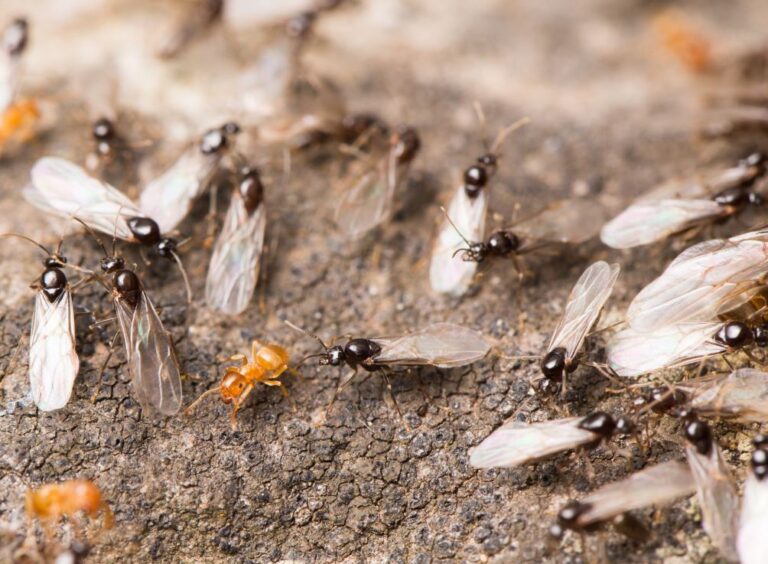
These agile, bearded aerial hunters capture insects mid-flight, including winged ants (alates) during nuptial flights. They have a stout proboscis designed to pierce exoskeletons and inject neurotoxic saliva.
5. Phorid Flies (Family: Phoridae)
Also known as “ant-decapitating flies,” these are gruesomely specialized parasitoids. A female fly lays an egg inside an ant’s body. The larva hatches and migrates into the ant’s head, eventually consuming the brain and causing the head to fall off. The larva then pupates inside the detached head.
6. Beetles (Multiple Families)
- Ground Beetles (Carabidae): Many are voracious nocturnal predators of ants on the soil surface.
- Rove Beetles (Staphylinidae): Some species live as predators or scavengers within ant nests, protected by their chemical secretions.
- Ant-eating Beetles (Anthicidae): Specialized ant predators with narrowed “waists” that help them escape ant grabs.
7. Wasps (Multiple Families)
- Spider Wasps (Pompilidae): Some species provision their nests with paralyzed ants, rather than spiders.
- Velvet Ants (Mutillidae): Actually wasps, the females are wingless and heavily armored. They parasitize ant and bee nests, consuming larvae.
- Muddauber Wasps: Some species are known to capture and paralyze ants, storing them in their mud cells for their larvae to eat.
Comparison Table: Top Ant Predators at a Glance
| Predator | Type | Primary Hunting Method | Life Stage that Eats Ants | Specialist or Generalist? |
|---|---|---|---|---|
| Antlion | Insect (Lacewing relative) | Pitfall trap ambush | Larva | Ant Specialist |
| Phorid Fly | Insect (Fly) | Parasitoid (lays egg in ant) | Larva | Obligate Ant Specialist |
| Ant-Mimicking Spider | Arachnid | Deception & ambush | Adult & Juvenile | Ant Specialist |
| Robber Fly | Insect (Fly) | Aerial pursuit | Adult | Generalist (incl. winged ants) |
| Praying Mantis | Insect | Active visual hunter | Adult & Nymph | Generalist (sometimes ants) |
| Ground Beetle | Insect (Beetle) | Nocturnal ground pursuit | Adult & Larva | Generalist (incl. ants) |
Ecological Impact: The Role of Ant-Eating Bugs
These predators serve as crucial natural population controls for ants. By preying on foragers, reproductives, or larvae, they:
- Regulate Ant Populations: Prevent any single ant species from dominating an ecosystem.
- Benefit Plants: Reduce herbivorous ant species that protect sap-sucking pests like aphids.
- Soil Aeration: Antlion pits and beetle digging contribute to soil turnover.
- Food Web Support: They, in turn, become food for birds, lizards, and larger insects.
Ant Defenses: How Ants Fight Back
The constant pressure from predators has driven the evolution of remarkable ant defenses:
- Swarming: Overwhelming a predator with numbers.
- Chemical Warfare: Formic acid, alkaloids, and sticky sprays.
- Soldier Castes: Large-jawed ants dedicated to colony defense.
- Avoidance: Changing foraging trails and nest locations.
Natural Pest Control: Harnessing Ant Predators in Your Garden
While introducing specialist predators like Phorid flies is impractical, you can encourage native ant-eating bugs by:
- Reducing Broad-Spectrum Pesticides: These chemicals kill beneficial predators.
- Creating Diverse Habitats: Leave some sandy patches for antlions, bare soil for ground beetles, and plant diversity for spiders and wasps.
- Tolerating Some Ants: A healthy ant population supports the predators that help keep them in balance.
Frequently Asked Questions (FAQ)
Q: Do ladybugs eat ants?
A: No. Ladybugs are aphid specialists. They often compete with ants that farm aphids for honeydew, but they do not prey on the ants themselves.
Q: What is the most effective natural predator of fire ants?
A: In their native South American range, Phorid flies (Pseudacteon spp.) are a major biological control agent. Several species have been introduced in the southern U.S. to help manage invasive fire ant populations.
Q: Do ants eat other ants?
A: Yes! This is called ant predation or dulosis (slavery). Army ants famously raid other ant colonies, and slave-making ants like Polyergus steal brood to raise as workers.
Q: Are ant-eating bugs dangerous to humans?
A: Almost never. These insects are focused on their ant prey. While a praying mantis or robber fly might defensively bite if handled, they are not venomous to humans.
Conclusion: A Delicate Balance
The world of bugs that eat ants is a compelling example of evolutionary arms race. From the cunning mimicry of spiders to the gruesome parasitism of Phorid flies, these predators have turned the tables on one of nature’s most successful social insects. By understanding and appreciating this dynamic, we gain a deeper insight into the complexity of backyard ecosystems and the importance of conserving biodiversity. The next time you see an ant trail, look closer—you might just witness a drama of predation unfolding in miniature.